The Characters of the Rennes-le-Château Affair
The Characters of the Rennes-le-Château Affair
The Rennes-le-Château affair cannot be reduced to the single figure of Abbé Bérenger Saunière. Behind the famous mystery surrounding this small village in the Aude lies a multitude of characters whose lives, relationships and actions helped shape one of France's most celebrated enigmas. Some are historical figures directly involved in the events, while others played an important role in spreading the theories and legends that developed over the course of the 20th century.
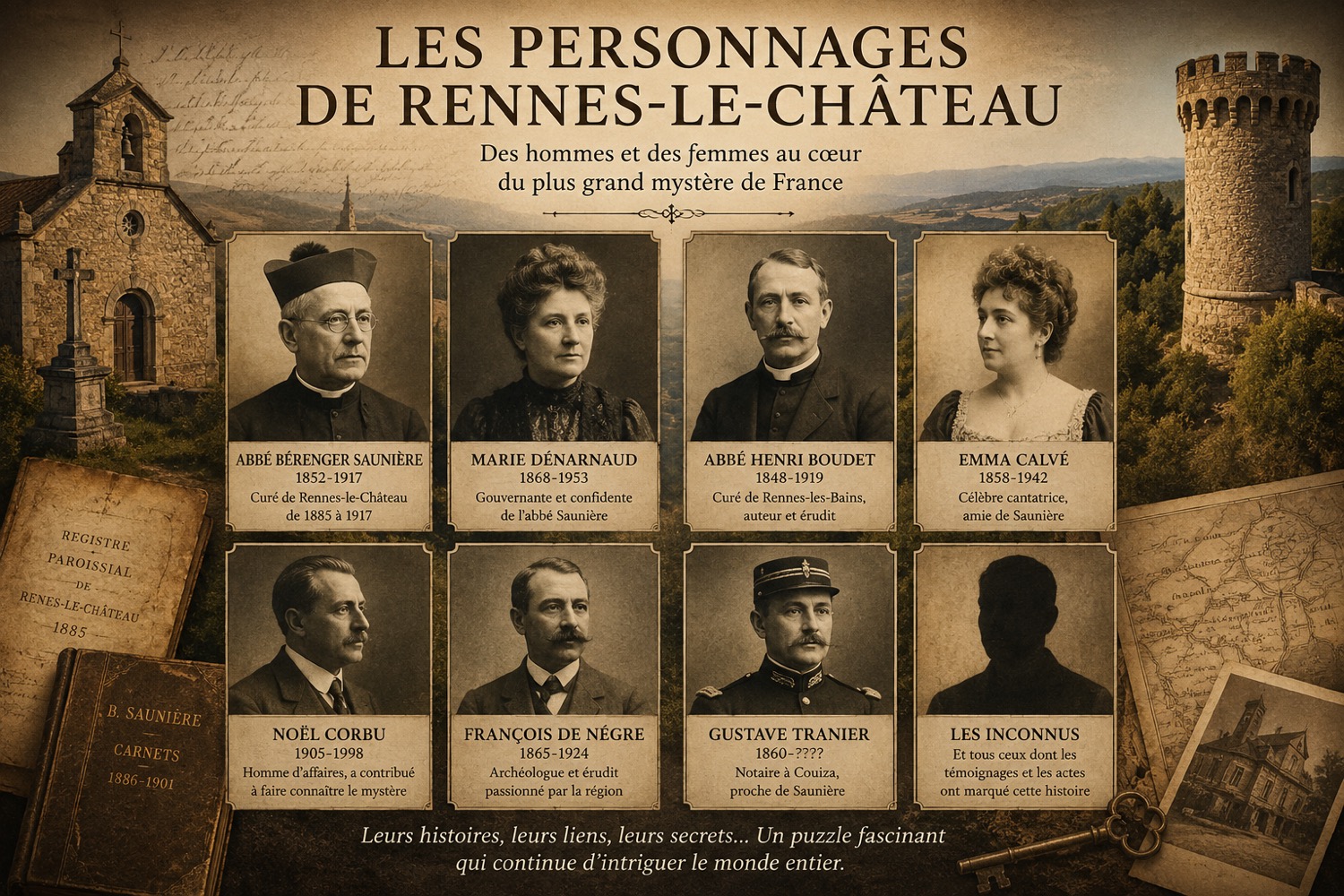
At the centre of this story is, naturally, Abbé Bérenger Saunière, appointed parish priest of Rennes-le-Château in 1885. His unexplained wealth, the major works carried out on the Sainte-Marie-Madeleine church, and the construction of the Magdala Tower gave rise to countless questions. His life is the starting point for most research devoted to the mystery.
Alongside him stands another essential figure: Marie Dénarnaud. Housekeeper, collaborator and confidante of the priest for more than thirty years, she took part in managing the estate and remained by his side until Saunière's death in 1917. As heir to his estate, she kept its secrets for several decades. Her statements, sometimes cryptic, have greatly fuelled speculation about the possible existence of a treasure or an extraordinary discovery.
Among the most studied figures is also Abbé Henri Boudet, parish priest of the neighbouring village of Rennes-les-Bains. Author of the work La Vraie Langue Celtique et le Cromleck de Rennes-les-Bains, published in 1886, he is often associated with the theories surrounding Rennes-le-Château. Some researchers see his writings as simple scholarly works, while others search them for hidden messages or symbolic clues.
The history of Rennes-le-Château cannot be understood without mentioning the villagers who lived alongside Abbé Saunière. Their accounts, passed down from generation to generation, are a valuable source for historians. Although some stories have been embellished over time, they help us better understand the local context in which the events took place.
During the 20th century, new figures came to play an essential role in popularising the mystery. Among them was Noël Corbu, owner of the Saunière estate after the Second World War. Eager to attract visitors to his establishment, he did much to spread the idea of a treasure discovered by the priest. His statements drew media attention and marked the beginning of Rennes-le-Château's international fame.
Several authors and researchers subsequently helped fuel the phenomenon's growth. Their works, sometimes based on historical archives, sometimes on more speculative hypotheses, helped make the village known well beyond France's borders. Some favour a historical approach, while others explore avenues linked to treasure, secret societies, the Templars, the Cathars, or supposed religious secrets.
Other figures also appear in the accounts linked to the affair: clergymen, local notables, benefactors, artists and prestigious visitors who frequented Abbé Saunière's estate. Each sheds particular light on this complex period, where historical reality, rumour and legend intertwine.
Studying the characters of Rennes-le-Château helps to better separate documented facts from the interpretations that have accumulated over time. Behind the most famous theories are, above all, men and women who lived within a specific historical context, with their own ambitions, convictions, relationships and, sometimes, secrets.
This section is devoted to all the figures who shaped the history of Rennes-le-Château. Here you will discover their biographies, their links to the affair, the documents concerning them, and the various interpretations developed by researchers. By exploring these often surprising life stories, it becomes possible to better understand how one of the most fascinating enigmas in contemporary French history came into being and developed.